
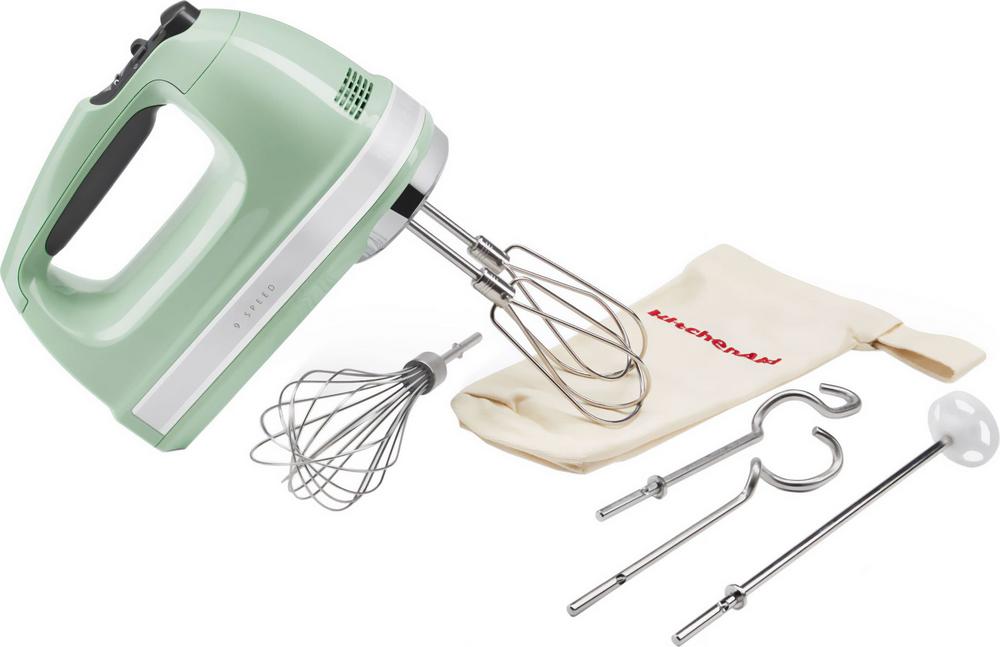
If you love to bake but don’t have space (or budget) for a big stand mixer, a quality hand mixer can be the perfect middle ground. Compact, powerful and easy to store, it’s often the first “proper” kitchen gadget bakers invest in. In this guide we’ll use the KitchenAid 5KHM9212BAC Hand Mixer in Almond Cream as a reference point, and walk through what to look for in a hand mixer, how to decide between corded and cordless models, and some stylish alternatives to consider.
Why a hand mixer still deserves a place in a modern kitchen
Hand mixers have been quietly getting better over the years. Where older models could feel underpowered and noisy, today’s premium mixers are smoother, more controlled and much easier to live with day-to-day.
The KitchenAid 5KHM9212BAC is a good example of why many bakers upgrade from a basic mixer. It’s designed to be sturdy, comfortable to hold and capable of tackling everything from light sponges to thicker cookie doughs. If you want to see how it performs recipe-by-recipe, you can read our full review of the KitchenAid 5KHM9212BAC Hand Mixer after this guide.
Key features that actually matter on a hand mixer
Standing in front of a shelf of mixers (or pages of online listings) can be confusing. To keep things simple, focus on these practical points rather than marketing jargon.
Speed control and smooth starts
One of the biggest upgrades when you move to a more premium mixer is better speed control. Models like the KitchenAid 5KHM9212BAC usually offer several speed settings with a gentle ramp-up, so you don’t blast flour or icing sugar all over the worktop the second you press the button.
Look for:
- A low first speed for folding in dry ingredients.
- Enough higher settings for whipping cream and egg whites efficiently.
- Smooth transitions between speeds so the mixer doesn’t lurch in your hand.
Comfort and weight in the hand
A hand mixer might be used for several minutes at a time, so how it feels to hold matters. A well-balanced mixer should feel stable with the weight sitting above your hand instead of dragging down at the front. The 5KHM9212BAC is designed with this in mind, and many users find it noticeably more comfortable than old clunky models.
When you’re choosing, consider:
- Handle shape and grip – does it look like you could hold it securely with one hand?
- Position of the buttons – you want to adjust speed without shifting your grip.
- Overall weight – heavy enough to feel solid, but not so heavy that your wrist aches.
Attachments: what do you really need?
Most quality hand mixers come with at least three core accessories: standard beaters, dough hooks and a whisk or blending attachment. The KitchenAid 5KHM9212BAC includes three accessories as standard, giving you good versatility straight out of the box.
As a rough guide:
- Standard beaters – for cake batter, cookie dough, mashed potatoes and general mixing.
- Dough hooks – for small batches of softer bread or pizza dough.
- Whisk-style attachment – for whipped cream, meringues and fluffy mousses.
If a mixer you’re considering doesn’t include at least beaters and dough hooks, check whether they’re available separately, as that can add to the overall cost.
Corded vs cordless hand mixers: which suits you?
One of the biggest decisions now is whether to go for a classic corded model like the KitchenAid 5KHM9212BAC, or a cordless mixer such as the KitchenAid 5KHMB732BAC Cordless Hand Mixer.
Why choose a corded hand mixer?
Corded mixers remain the go-to choice for most regular bakers. With constant mains power, you don’t have to think about charge levels or battery life, and they tend to offer slightly more consistent oomph on thicker mixtures.
A model like the 5KHM9212BAC is ideal if you:
- Do longer mixing sessions or multiple recipes in one go.
- Don’t want to think about charging or battery care.
- Prefer a familiar, plug-in-and-go setup.
If you want to know how the cord length and cable management perform in a real kitchen, you can dive into our in-depth KitchenAid 5KHM9212BAC review for more details.
When a cordless mixer makes more sense
Cordless mixers, like the 5KHMB732BAC, free you from the socket completely. They’re brilliant for smaller kitchens where the plug is awkwardly placed, for moving between islands and worktops, or for anyone who simply dislikes trailing cables.
Choose cordless if you:
- Often bake in a space where sockets are limited or far away.
- Like a clutter-free worktop and hate cables draping over bowls.
- Mostly do shorter mixing tasks rather than long, heavy-duty sessions.
Modern cordless mixers are designed to cope with everyday baking tasks, but if you regularly tackle thick doughs or large batches, you may still appreciate the extra consistency of a corded model.
Style and colour: matching your mixer to your kitchen
For many people, a hand mixer is permanently on display, either hung on a rail or tucked neatly on a shelf. That’s where colour and design come in. The KitchenAid 5KHM9212BAC in Almond Cream is particularly popular in classic or neutral kitchens, adding a soft, warm tone rather than stark white.
If you’re set on the 5KHM9212 range but prefer a darker look, the KitchenAid 5KHM9212BOB Hand Mixer in Onyx Black is worth a look. It offers a similarly capable package with a sleek black finish that suits modern, monochrome or industrial-style spaces.
Retro charm: Smeg hand mixer alternatives
If you love the idea of a hand mixer that doubles as a design statement, the retro-inspired models from Smeg are designed with exactly that in mind. The Smeg 50’s Retro HMF01BLUK Hand Mixer in Black and the pastel-toned Smeg 50’s Retro HMF01PGUK Hand Mixer in Pastel Green bring 1950s styling with modern functionality.
These are ideal if you:
- Already own other retro-style appliances and want everything to match.
- Prefer soft, rounded designs over more contemporary lines.
- Want your mixer to be a feature rather than something to hide away.
Functionally, they sit in a similar bracket to the KitchenAid options, with multiple speeds and core accessories included, so you can choose largely on the balance of looks, feel and brand preference.
How much should you spend on a hand mixer?
Hand mixers range from very basic budget models to premium, design-led appliances. The KitchenAid and Smeg ranges sit firmly in the premium camp, with prices that reflect their build quality, design, and brand reputation.
It can help to think in terms of how you’ll actually use the mixer:
- Occasional baker – If you bake a couple of times a month, a reliable mid-range mixer is usually enough, but investing in a more refined model may make the experience more enjoyable.
- Weekly baker – If you bake most weekends, it’s worth paying more for a mixer that feels solid and comfortable, with smooth speed control and decent attachments.
- Enthusiast – If you’re regularly making meringues, macarons and enriched doughs, a premium model like the 5KHM9212BAC starts to feel more like a kitchen essential than a treat.
Remember that a good hand mixer can last many years, so the cost per use is often lower than it looks at first glance.
Practical tips for using a hand mixer like a pro
Whichever model you choose, a few simple habits can make your mixer easier to use and help recipes turn out more consistently.
Start slow, then build up speed
Always begin at the lowest speed to bring ingredients together gently, especially with dry ingredients like flour or icing sugar. Once everything is roughly combined, gradually increase the speed until you reach the level needed for the recipe. This not only keeps your kitchen cleaner but also prevents overworking delicate mixtures.
Use the right attachment for the job
It’s tempting to leave the standard beaters on for everything, but swapping attachments pays off:
- Use dough hooks for small dough batches instead of beaters, as they’re designed to turn and stretch the dough more effectively.
- Use a whisk attachment for cream and egg whites to incorporate air more quickly.
- Stick with standard beaters for batters, cake mixes and general mixing tasks.
Don’t overmix
With a capable mixer, it’s surprisingly easy to go too far. Once flour is incorporated into cake batter, for example, you only need a short mix to reach a smooth consistency. Overmixing can make cakes dense and tough, so stop as soon as the mixture looks even.
Caring for your hand mixer so it lasts longer
Premium mixers are built to last, but a little care goes a long way in keeping them looking and performing at their best.
Cleaning after each use
Detach the accessories and wash them in warm soapy water (or the dishwasher if they’re marked as dishwasher-safe). Wipe the main body with a soft damp cloth, taking care not to let water get into the vents or controls. Clean splashes promptly so they don’t harden, especially around seams and buttons.
Storing neatly and safely
Store the mixer with attachments removed, ideally in a drawer, cupboard or storage box where they won’t get bent or scratched. Some people like to keep attachments in a small pouch or container so they don’t rattle around. If you’re short on space, a corded model can be looped and secured with a simple cable tie to keep everything tidy.
Being kind to the motor
Hand mixers are powerful for their size, but they do have limits. Avoid running at full speed for very long periods, and if the mixer struggles with a mixture, it’s better to stop and adjust the recipe or quantity than to force it. This helps prevent overheating and keeps the motor healthy over the long term.
Which hand mixer is right for you?
If you’re leaning towards a corded premium mixer with a classic, neutral finish, the KitchenAid 5KHM9212BAC in Almond Cream is a very strong all-round choice for regular bakers. It combines practical features with a timeless look that suits most kitchens. For a deeper dive into how it handles real recipes, noise levels and day-to-day use, you can read our full review of the KitchenAid 5KHM9212BAC Hand Mixer with 3 Accessories.
If you prefer a darker, more contemporary style, the KitchenAid 5KHM9212BOB in Onyx Black offers a similar proposition in a sleeker finish. For those tempted by the cable-free life, the KitchenAid 5KHMB732BAC Cordless Hand Mixer lets you move freely around the kitchen with no trailing lead.
Love retro styling? The Smeg 50’s Retro HMF01BLUK in Black and the soft, minty HMF01PGUK in Pastel Green are both stylish options that can tie together a vintage-inspired kitchen.
Final thoughts
A hand mixer is one of those appliances that quietly transforms baking from a chore into something you genuinely look forward to. Pick the right one, and you’ll have a compact, reliable helper on hand for everything from weeknight pancakes to special-occasion desserts.
Whether you choose the KitchenAid 5KHM9212BAC in Almond Cream, go cordless, or opt for a retro alternative, focus on comfort, control and the types of recipes you actually make. Then, when you’re ready to drill into the details, you can use the in-depth reviews linked throughout this guide to confirm which model will earn its place on your worktop for years to come.