Home » Product Reviews » Sound & Vision » TVs » Hisense U7Q 55″ 4K Ultra HD MiniLED Smart Freely TV [2025] review
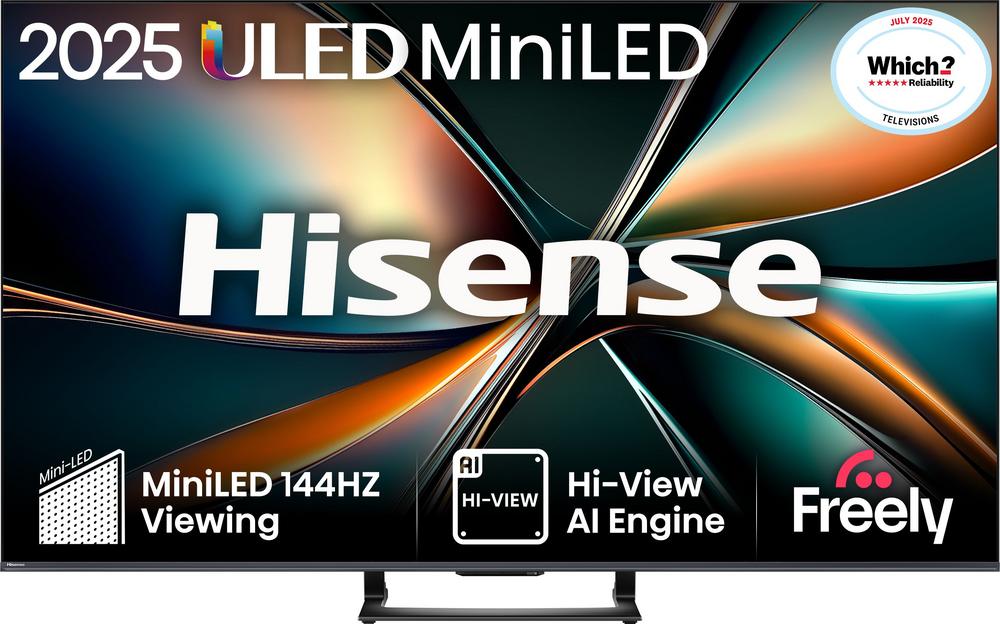
The Hisense U7Q 55U7QTUK is a 55-inch 4K MiniLED TV aimed at households that want a premium viewing experience without paying flagship money. With its Quantum Dot panel, full array dimming and 144Hz refresh rate, it reads more like a high-end spec sheet than a mid-range telly.
Hisense has built a strong reputation for offering strong performance at keen prices, and this 2025 model continues that theme. The Low Reflection Screen, Dolby Vision and Dolby Atmos support, plus built-in Freely for aerial-free live TV, make it a very complete package.
Owners seem happy too: an average score of 4.7 out of 5 from 445 reviews suggests picture quality and everyday usability are living up to the promise.
This 55-inch Hisense is ideal for a main living room TV in small to medium-sized homes, where you sit a couple of metres away and want something that feels cinematic without overwhelming the space. The 4K resolution, MiniLED backlight and Quantum Dot colour all come into their own with films, sport and streaming boxsets.
It suits families and casual viewers who want an easy life, thanks to Freely (for live channels without an aerial), built-in apps via VIDAA, and features like voice control and Apple AirPlay 2. If you’re upgrading from an older HD or basic 4K set, it will feel like a big step up in contrast, brightness and smart features.
Gamers are also well catered for. The 144Hz Game Mode Pro, AMD FreeSync Premium and low response time are tailored to next-gen consoles and gaming PCs, reducing blur and tearing so fast action looks smooth.
Budget-wise, this sits in the mid-range: not a bargain-basement option, but very competitive for a MiniLED with this many features. It’s a good fit if you want something that feels premium but don’t want to pay top-tier brand prices.
The MiniLED panel with full array dimming and Quantum Dot colour delivers a bright, punchy picture with strong contrast and a wide colour gamut (DCI-P3). That means vivid HDR movies and sport with more depth than standard LED TVs.
Dynamic Tone Mapping Pro and Dolby Vision support help optimise brightness scene by scene, so dark dramas retain detail instead of turning into murky grey. The wide 178° viewing angles mean everyone on the sofa gets a good view.
For gaming, the 144Hz refresh rate, 6 ms response time and AMD FreeSync Premium reduce motion blur and screen tearing, while the dedicated Game Bar makes it fast to tweak settings mid-session.
The Low Reflection Screen is a real plus if your room has big windows or lamps, helping the picture stay watchable in brighter spaces. Freely is another standout: being able to watch live TV over broadband without an aerial simplifies setup, especially in rentals.
On the audio side, the built-in 2.1-channel system with a subwoofer, Dolby Atmos, DTS:X and IMAX Enhanced support means sound is richer and more immersive than many slim TVs, without needing a soundbar on day one.
The energy rating is E, and HDR consumption is quoted at 110 kWh per 1000 hours, so it’s not the most economical TV to run if you watch a lot, especially in HDR.
While VIDAA is perfectly capable, it’s not as slick or app-rich as some rival platforms. Most major services are covered, but if you’re used to the very latest Google TV or webOS interfaces, this may feel a little less polished.
There’s no built-in support for Google Assistant, only Amazon Alexa and generic voice control, which may disappoint if you’re invested in Google’s ecosystem.
Although the onboard sound is better than many, serious film fans will still want a separate soundbar or AV system to really take advantage of Dolby Atmos and IMAX Enhanced content.
Living with the Hisense U7Q is straightforward from day one. The 55-inch screen and slim 7.7 cm depth make it easy to position on furniture, and the 400 mm stand width suits most standard TV units. There’s also support for a 400 x 200 mm VESA wall mount if you prefer a cleaner look.
The VIDAA operating system offers a simple, tile-based interface that’s easy to navigate with the supplied remote. Voice control saves time when searching for shows, and Apple AirPlay 2 plus screen mirroring make it quick to cast content from phones, tablets or laptops.
Freely removes the hassle of aerial cabling for many households, especially if your broadband is reliable. Timeshift and the EPG (programme guide) make live TV easy to manage, and the sleep timer is handy if you tend to nod off mid-episode.
Connectivity is generous day-to-day: four HDMI ports (with eARC for a soundbar), two USB ports, Ethernet, Wi-Fi and Bluetooth 5.0 cover most setups without constant cable swapping. A headphone socket is helpful for late-night viewing without disturbing others.
Menu options like Filmmaker Mode, Dolby Vision presets and equaliser controls are clearly labelled, so you can fine-tune picture and sound without needing to be an expert.
Core picture performance is the star. The MiniLED backlight, full array dimming and 450-nit typical brightness combine to produce crisp 4K images with solid black levels and minimal blooming for this price bracket. Quantum Dot Colour extends the range of shades, making nature documentaries and animated films look especially rich.
HDR support is comprehensive, with Dolby Vision for scene-by-scene tone mapping and Dynamic Tone Mapping Pro working to keep both highlights and shadows detailed. Wide viewing angles mean colours and contrast hold up well even when you’re off-centre.
Gamers get a substantial feature set: 144Hz Game Mode Pro, AMD FreeSync Premium and a 6 ms response time help keep input lag low and action smooth. The dedicated Game Bar makes it easy to monitor frame rate and adjust key settings on the fly.
Sound performance is above average for a flat TV. The 2.1-channel arrangement, 20W output and built-in subwoofer give more weight to dialogue and soundtracks than many slim sets. Dolby Atmos, DTS:X and IMAX Enhanced support ensure compatible content can make full use of virtual surround effects, especially when paired with an eARC soundbar later on.
Smart features round things off: VIDAA brings streaming apps and web browsing, Apple AirPlay 2 and screen mirroring support casting, and Alexa compatibility enables voice control from a smart speaker. HbbTV 2.0.4 support ties broadcast and online services together, improving catch-up and interactive features.
At £599, the Hisense U7Q undercuts many big-brand MiniLED rivals while offering a comparable headline spec: 4K resolution, full array dimming, Quantum Dot, 144Hz panel and strong gaming credentials. That makes it a compelling mid-range choice for buyers looking for high-end features without a premium price tag.
The strong 4.7 average review score from 445 owners reinforces the sense that you’re getting solid performance and reliability for the money. The two-year manufacturer warranty adds a welcome extra layer of reassurance.
Given the quality of the panel, the breadth of HDR and audio format support, and the inclusion of Freely (which can save on aerial installation costs), this model represents very good value if you’re happy with the VIDAA platform and don’t require Google Assistant.
The Hisense U7Q 55U7QTUK is a well-judged MiniLED TV that brings premium picture tech, strong gaming specs and a surprisingly capable sound system to a mid-range price point. Its bright, colourful panel, low reflection screen and wide format support make films, sport and streaming a pleasure to watch.
It’s especially appealing for families and gamers who want an all-rounder: Freely simplifies live TV, while the 144Hz refresh rate and FreeSync Premium give next-gen consoles the platform they deserve. Everyday operation is simple, and connectivity covers almost every scenario.
If you prioritise the very slickest smart interface or absolute top-tier energy efficiency, there are alternatives to consider. But for most buyers wanting a feature-rich 55-inch MiniLED without overspending, this Hisense is an excellent choice that comfortably stands out in its class.
