
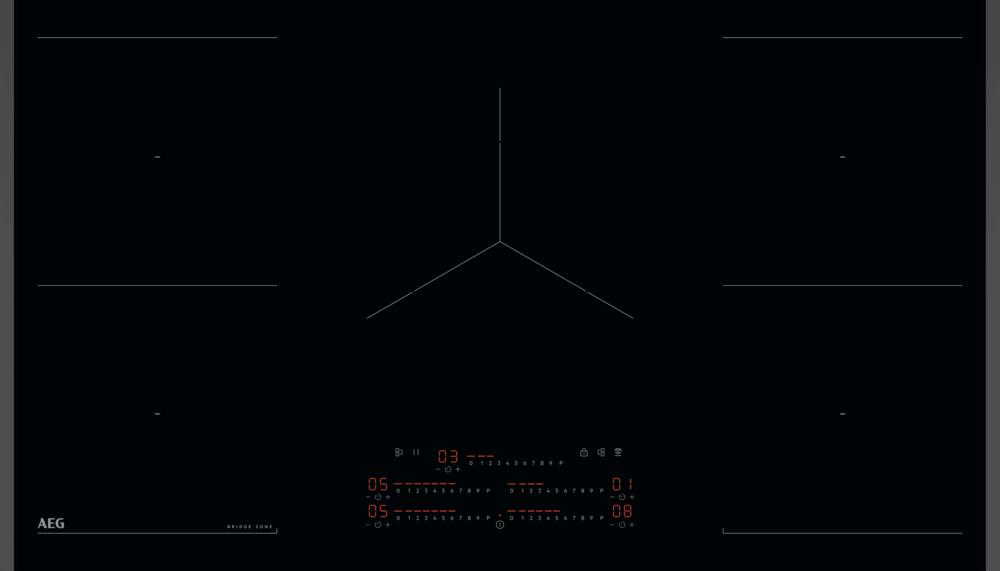
A wider hob can make a busy kitchen feel easier to manage, giving you more room to move between pans and prepare several dishes at once. But width is only part of the story: your worktop, cookware, electrical supply and extractor all affect whether a new induction hob will work for you.
The AEG 6000 Multibridge TK95IN00FB is a useful starting point for exploring these choices. It is a 91cm black induction hob with five cooking zones, double bridging zones and touch controls. This guide explains what those features mean in everyday cooking, what to check before installation and how narrower alternatives might fit your kitchen.
For a closer look at the model itself, read our AEG TK95IN00FB review.
Why choose a wider induction hob?
A 91cm hob offers more potential cooking space than a typical narrower model. If you regularly make a main course, vegetables and sauce at the same time, five zones can give you more flexibility than a smaller layout. The extra width may also make it easier to arrange larger pans without handles crowding one another.
That said, five zones do not guarantee that every large pan will fit comfortably at once. Look at the zone layout and the size of the cookware you use most often. A family that cooks with several broad frying pans has different needs from someone who mostly uses small saucepans.
Induction heats suitable cookware directly, rather than relying on a conventional heated cooking surface. It responds quickly to setting changes, which can be helpful when moving from a rapid boil to a gentler simmer. The glass can still become hot from contact with the pan, so it should not be treated as cool immediately after cooking.
Check the space before choosing a 91cm hob
The TK95IN00FB is listed as 91cm wide and 52cm deep. Measure the available worktop in both directions, remembering to account for nearby walls, splashbacks and any overhangs. The visible dimensions are not the same as the cut-out dimensions: use the installation instructions for the exact opening and clearances required.
Also look below the worktop. The cabinet, any drawers and appliances underneath must allow the clearances and ventilation specified by the manufacturer. If you are replacing an existing hob, do not assume the old opening will suit the new one, even if the two appliances look similar in size.
The published height is listed as 0cm, which is not a useful installation measurement. Check the manufacturer’s installation documents or ask the retailer for the full dimensions before ordering.
Think about the extractor too
A wider cooking area deserves an extractor arrangement that can serve it effectively. Check the hood’s dimensions, installation height and compatibility with your kitchen layout. If you want automatic control, the hob’s Hob2Hood feature needs a compatible cooker hood; it should not be assumed to work with an existing extractor.
How bridging zones help with larger cookware
The AEG’s double bridging zones are designed to create larger cooking areas by combining compatible zones. That can be useful for a suitable griddle or larger pan when a single zone would not cover the cooking area as conveniently.
Before choosing cookware, consult the instructions for the hob’s bridging arrangement, recommended pan dimensions and positioning. A large dish is not automatically suitable for induction, and an uneven base may make cooking less consistent.
Consider how often you will use this flexibility. If weekend breakfasts involve a griddle or you cook larger meals for guests, bridging could be valuable. If you mainly heat one or two small pans, a narrower hob may be a more practical use of worktop space.
Choose induction-compatible pans
Induction cookware needs a suitable magnetic base. Many stainless-steel and cast-iron pans work, while aluminium or copper pans generally need an induction-compatible base added by the manufacturer. Look for an induction symbol on the pan or its packaging.
A simple magnet test can help: if a magnet sticks firmly to the base, the pan is likely to be compatible. It is not a complete guarantee of performance, however, so also check the manufacturer’s guidance and use a pan that fits the chosen zone.
- Choose flat, stable bases for good contact with the glass.
- Check that a griddle is suitable for both induction and bridged zones.
- Keep pan bases clean and dry to help protect the surface.
- Lift heavy cookware rather than dragging it across the glass.
The TK95IN00FB includes pan detection, but an incompatible, undersized or incorrectly positioned pan may not be recognised. If a pan does not heat, check these points and the hob instructions before assuming there is a fault.
Getting comfortable with the controls
The hob uses TouchSlider controls rather than physical knobs. These provide a tidy surface and let you change settings by touch, though it is worth familiarising yourself with the layout before cooking a full meal. Keep the control area clean and refer to the manual if a spill or an object affects operation.
PowerBoost is listed among the features and can be useful when you want a rapid burst of heat, such as when bringing water towards the boil. Use the appropriate lower setting afterwards for the food you are cooking, and follow the instructions for any limits on boost use.
There are also pause and Stop&Go functions, a child lock and residual heat indicators. The lock can help prevent unintended control changes, but it is not a substitute for supervising children around a cooking area. Residual heat indicators are a useful reminder to leave the glass alone until it has cooled.
One detail is worth checking if timed cooking matters to you: the listing says an Eco timer is included but also states that there is no timer. Confirm the precise timer functions with the retailer or manufacturer before relying on them.
Installation: what to arrange before delivery
Induction hobs vary in their electrical requirements, and a large model should not be assumed to work from an ordinary plug socket. The TK95IN00FB listing says a plug and cable are not included. Ask a qualified electrician to check the appliance instructions, your existing circuit and the connection materials needed before installation.
Budget for any necessary electrical work as well as fitting the hob. If a new cut-out is needed, consider who will make it and whether the worktop material requires a specialist. Arrange installation only after checking the required clearances and ventilation.
Keep the product information and purchase documentation handy for warranty queries. The listed manufacturer warranty is two years; check its terms and any registration requirements when you buy.
Cleaning and caring for a matt glass surface
The TK95IN00FB has a SaphirMatt glass surface and bevelled edges on two sides. A smooth hob is straightforward to wipe around compared with a surface full of burners and supports, but matt glass still needs appropriate care.
Let the surface cool before routine cleaning, then use a soft cloth and products recommended in the manufacturer’s instructions. Avoid abrasive scourers and harsh cleaners that could mark the finish. For stubborn residue, follow the specific care guidance rather than scraping indiscriminately.
Wipe spills promptly when it is safe to do so, paying particular attention to sugar-rich spills as directed in the manual. Keeping the underside of pans clean and lifting them into place can also help minimise marks over time.
Which AEG alternatives are worth considering?
The right alternative depends on the space you have and the way you cook. These models provide useful starting points for comparing sizes and configurations; check their individual specifications and current prices before deciding.
For a smaller worktop
The AEG IPE64551FB 59cm induction hob is a natural option if a 91cm appliance would dominate your worktop. It may suit a smaller household or a kitchen where preparation space is more important than accommodating several pans at once.
For a middle ground
The AEG 6000 Multibridge TK85IM00FB 80cm induction hob is another model in the Multibridge family, but with a narrower stated width. Compare its layout and installation requirements if you want more room than a compact hob provides without moving up to 91cm.
Also consider the AEG IAE84421FB 78cm induction hob and the AEG TI84IB00FZ 81cm induction hob. Their similar overall widths make them useful comparisons, although the arrangement of zones, controls and fitting requirements may matter more than a few centimetres of difference.
For a different fuel combination
The AEG HDB95623NB 88cm mixed-fuel induction hob is worth exploring if you are interested in a mixed-fuel configuration rather than induction alone. Check the individual fuel and connection requirements carefully, as installation needs will differ from an all-electric induction model.
Make the choice that fits your kitchen
Start with measurements and installation requirements, then think about your everyday pans and the number of dishes you actually cook together. The TK95IN00FB’s wide layout and bridging features may be appealing for larger cookware, while a narrower model could leave you with more useful preparation space.
There is no need to decide on width alone. Explore the linked alternatives and our in-depth AEG 6000 Multibridge TK95IN00FB review to compare the details before choosing a hob that fits both your kitchen and your cooking habits.