
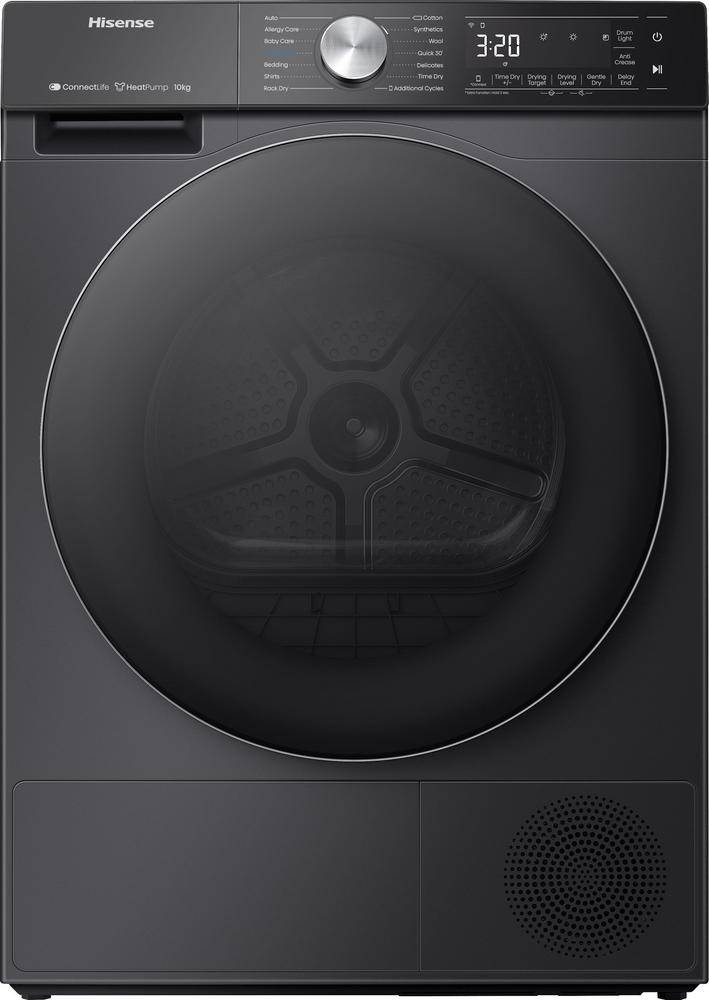
Choosing a new tumble dryer is no longer just a case of picking the biggest drum for the lowest price. With energy costs high and families relying on their dryers all year round, it pays to spend a bit of time figuring out which heat pump tumble dryer will actually work best in your home. The Hisense 5S Series DH5S102BW 10Kg Heat Pump Tumble Dryer is a strong example of where the market is heading: big capacity, very high energy efficiency, and plenty of user-friendly features.
Why look at a 10kg heat pump tumble dryer in the first place?
A 10kg drum size is aimed squarely at families and busy homes. It’s designed to swallow big bedding loads, thick towels and those hefty mixed washes that would overwhelm a smaller machine.
Pair that with heat pump technology and you get a dryer that is tuned for efficiency rather than brute-force heating. Instead of blasting clothes with fresh hot air and venting it outside, a heat pump system recycles the warmth, using less electricity to reach the same results. That’s why models like the Hisense 5S Series DH5S102BW often carry an A+++ rating, putting them among the most economical dryers you can buy.
If you are interested in this specific machine, you can read our full review of the Hisense 5S Series DH5S102BW 10Kg Heat Pump Tumble Dryer for a deep dive into performance and real-world use.
Understanding drum size: do you really need 10kg?
Before settling on any tumble dryer, think honestly about how much laundry you do in a typical week and what kinds of items you wash most often.
When a 10kg drum makes sense
- Households of four or more, especially with children creating frequent washing.
- Regular king-size or super-king duvet covers, mattress protectors and bulky blankets.
- Sports kits, school uniforms and workwear that need fast turnaround in cooler months.
The Hisense 5S Series DH5S102BW sits perfectly in this family category. A 10kg drum gives noticeably more breathing room for bedding and heavy cotton loads than an 8kg or 9kg appliance, helping clothes dry more evenly and reducing creasing.
When you might be better with 8–9kg instead
If your home is smaller, or you do laundry little and often, stepping down a size can be a smart move. That’s where the close relatives of the 5S Series come in:
- Hisense 3S Series DH3S802BB3 Wifi Connected 8Kg Heat Pump Tumble Dryer – ideal if space is tight and most loads are clothes rather than bedding.
- Hisense 3S Series DH3S802BW3 Wifi Connected 8Kg Heat Pump Tumble Dryer – similar 8kg capacity in white, which may blend better with existing kitchen or utility appliances.
An 8kg model will usually be slightly cheaper to buy and may run a touch faster on smaller loads, while still benefiting from the same heat pump efficiency.
Energy ratings and running costs: what A+++ actually means
Most modern heat pump tumble dryers carry high energy ratings, but A+++ is about as good as it gets on traditional labels. In practice, this means the machine is engineered to reuse heat effectively and avoid over-drying.
With a large appliance like the Hisense 5S Series DH5S102BW, that rating matters. A big 10kg drum invites big loads, and those are exactly the cycles that can burn through electricity on an older vented dryer. With heat pump technology and smart sensors, the machine should cut the heat when clothes are dry rather than simply following a fixed timer.
If you want similar efficiency in a slightly smaller package, it’s worth looking at 9kg options such as the Hisense 3S Series DH3S902BB3 Wifi Connected 9Kg Heat Pump Tumble Dryer or the Hisense 3S Series DH3S902BW3 Wifi Connected 9Kg Heat Pump Tumble Dryer. They sit just under the 10kg mark but still offer generous capacity and efficient performance.
Heat pump vs traditional dryers: practical differences at home
On paper, heat pump dryers seem like an easy win: lower running costs, no external vent and gentle drying. But what does that feel like day to day?
Drying times
Heat pump models can be slower than traditional vented machines, particularly on full cotton loads. You trade a bit of speed for the energy savings. For most families, this is easy to work around by planning loads earlier in the day, or using delay timers so clean laundry is ready when you wake up or return from work.
Gentler on fabrics
Because heat pump dryers operate at lower temperatures, clothes are not blasted with intense heat in every cycle. Over time, this can help colours stay brighter, elastic stay springy and towels avoid that stiff, over-dried feel. A larger drum, like the 10kg capacity in the Hisense 5S Series DH5S102BW, also helps protect fabrics by giving them room to move freely.
Installation flexibility
Most heat pump dryers are condenser-style units that collect water in a tank. You don’t need to run a vent hose out of a window or drill a hole through the wall, which gives you more options in a modern kitchen or utility room. Just ensure there is reasonable airflow around the appliance and that ambient temperatures don’t drop too low.
Living with a large-capacity heat pump dryer
Beyond the spec sheet, it’s worth thinking about the everyday experience of owning a big 10kg dryer. Here are a few practical points that often matter more than any individual feature.
Noise and placement
Large drums can be surprisingly quiet when well balanced, but all dryers generate some hum and drum movement. If your machine sits in an open-plan living area, you may value quieter evening cycles and the ability to delay start so the busiest programmes run when you are less likely to notice them.
Controls and programmes
Family-size machines commonly offer a long list of programmes for different fabric types. While it’s useful to have options for woollens, sportswear, mixed loads and bedding, the key is how easy it is to select the right one. Look for a clear dial, a readable display and a good selection of automatic sensor-based cycles, which most modern models in this range provide.
Maintenance
With any heat pump dryer, routine care makes a big difference to performance. Cleaning the lint filter after each cycle and checking the condenser or heat exchanger area regularly keeps air moving freely, so drying times stay consistent and energy use remains low.
Comparing Hisense 5S Series with 3S Series alternatives
If you have narrowed your choice to this family of dryers, it helps to think about how the 5S Series DH5S102BW sits alongside its smaller 3S Series siblings.
Capacity and household size
- 10kg: Best matched to large families, shared homes or anyone washing multiple bedding sets a week. This is where the Hisense 5S Series DH5S102BW really comes into its own.
- 9kg: A useful middle ground for three- or four-person households. The Hisense 3S Series DH3S902BB3 and Hisense 3S Series DH3S902BW3 both fit nicely in this bracket.
- 8kg: Suits couples or smaller families who still want a modern, efficient heat pump dryer. The 8kg 3S Series models mentioned earlier are solid examples.
Colour and styling
In many homes, looks matter. Some people prefer a bold dark finish to contrast with light cabinets, while others want appliances to quietly blend in. The 3S Series offers both black and white heat pump models, and the 5S Series DH5S102BW keeps things classic in white, which tends to remain timeless even if you update your kitchen around it.
Smart connectivity
Several models in the 3S Series come with Wi‑Fi connectivity, allowing app control, remote monitoring and cycle notifications. This can be handy if you often forget loads in the drum, or like to check progress from another room.
If you are curious about how those connected features work in everyday life, take a look at our in-depth write-ups of the 8kg black 3S Series dryer and the 9kg black 3S Series dryer. They give a clearer picture of how app integration can fit around a busy routine.
Tips for getting the best from a heat pump tumble dryer
Whatever size you choose, a few simple habits can make your heat pump tumble dryer perform at its best and keep bills in check.
Load it correctly
- Avoid overloading: clothes should have room to tumble freely so warm air can circulate.
- Don’t underload constantly: very small loads are less efficient; try to combine items where fabric types allow.
- Untangle bedding: shake out duvet covers and sheets so they don’t twist into a ball.
Choose the right programme
- Use cotton cycles for towels, bedding and sturdy garments.
- Opt for mixed or synthetics cycles for blended fabrics and everyday clothing.
- Consider low-heat or dedicated programmes for delicates and sportswear.
Use sensor drying wisely
Most modern heat pump dryers rely on moisture sensors to judge when clothes are dry. This is far more efficient than a simple timer and helps prevent over-drying. If you find clothes slightly damper than you like on your usual setting, step up one dryness level rather than switching to timed drying for everything.
Planning your laundry space around a 10kg dryer
Large-capacity dryers take up a similar footprint to smaller ones, but they do change how you use the room they live in.
Ventilation and ambient temperature
Heat pump dryers don’t need an external vent, but they do need some space to breathe. Ensure air can flow freely around the appliance and try to avoid very cold locations, which can make drying less efficient. A well-insulated utility room, kitchen corner or dedicated laundry space is ideal.
Storage for laundry baskets
Big loads mean big piles of clothes on either side of a cycle. Building in space for two baskets – one for wet laundry waiting to go in, and one for freshly dried items – makes the whole process smoother. If you often iron, leaving space for an ironing board nearby also helps.
Is the Hisense 5S Series DH5S102BW right for you?
The Hisense 5S Series DH5S102BW 10Kg Heat Pump Tumble Dryer is designed for households that want to combine generous capacity with very strong energy efficiency. With a rating around 4.9 out of 5 from hundreds of users, it clearly resonates with buyers who have already made the switch to heat pump technology.
If you are leaning towards a large 10kg model and want to know how this one copes with real-world family life, you can read the full in-depth review of the Hisense 5S Series DH5S102BW. It goes into more detail on noise levels, cycle times and day-to-day usability.
On the other hand, if your needs are closer to 8kg or 9kg, or you like the idea of Wi‑Fi connectivity and slightly smaller drums, the 3S Series alternatives listed throughout this guide are well worth a closer look via their dedicated reviews.
Final thoughts
Heat pump tumble dryers have moved from niche to mainstream, and for many homes they now make more sense than traditional vented models. A large-capacity A+++ machine like the Hisense 5S Series DH5S102BW puts you in a strong position to handle family-sized laundry with lower running costs and gentler care for fabrics.
Take a moment to match the drum size and features to your actual routine, explore the detailed product reviews linked above, and you’ll be in a great position to pick a dryer that should serve your home comfortably for years.